Wallace's Flying Frog
Rhacophorus nigropalmatus
A canopy frog that steers its own fall — and drops its tadpoles into a puddle stamped out by a much larger animal.
The frog that came down at a slant
Wallace's Flying Frog (scientific name: Rhacophorus nigropalmatus) is a large tree frog from the rainforests of Sundaland — the Malay Peninsula, southern Thailand, Sumatra, and Borneo. George Albert Boulenger described it in 1895 and gave it the name of Alfred Russel Wallace, the naturalist whose years in this archipelago helped shape the theory of evolution by natural selection.
Wallace had met the animal decades earlier in Sarawak. A workman brought him a frog and told him he had watched it come down from a high tree at an angle, as though it had flown. Wallace looked at its feet and found the account entirely credible:
"On examining it, I found the toes very long and fully webbed to their very extremity, so that when expanded they offered a surface much larger than the body."
Its conservation status is Least Concern. The species is spread across several large islands with no evidence of steep global decline — a statement about arithmetic across a region, not a promise about any particular forest inside it.
How a frog steers a fall
It does not fly. It falls on purpose, and slowly.
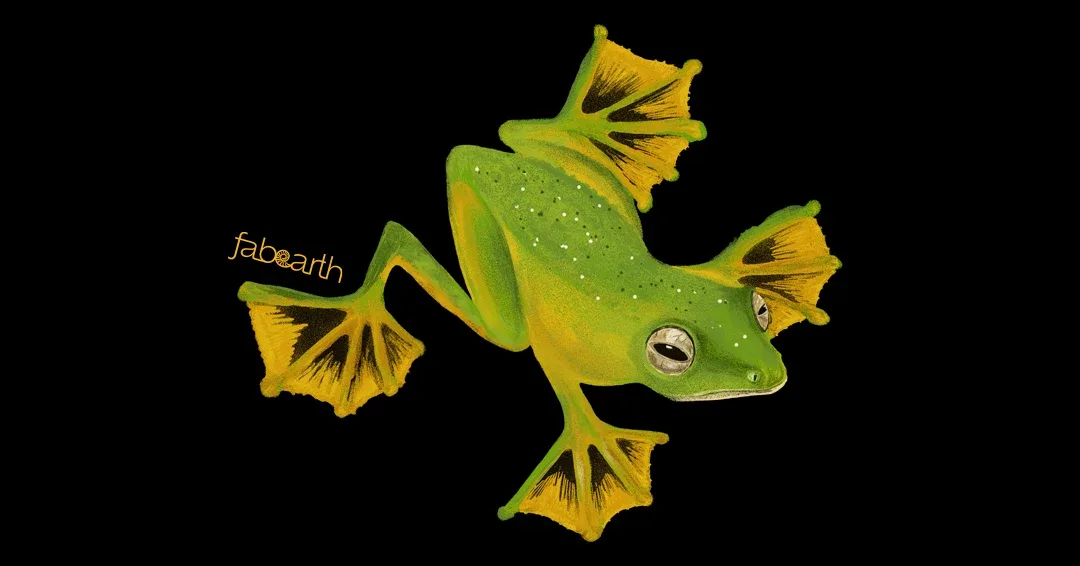
Webbing runs to the tip of every finger and toe. Fringes of skin widen the limbs. Oversized pads sit at the end of each digit. Opened together, all of that turns a falling animal into a surface, and a leap becomes a shallow diagonal that can cross fifteen metres or more between trees. The pads do the last part of the work, gripping bark at the end of a crossing that ends in a landing rather than a drop.
The scale is what makes it strange to watch. Females reach about a hundred millimetres from snout to vent and males about ninety, which puts this among the largest frogs of its genus. This is not a small animal drifting on air resistance. It is a palm-sized frog committing to a gap.
Its colouring reads as decoration and works as concealment: shining green above, pale below, with brilliant yellow along the inner toes and the outer edge of the webbing, and jet black where the webs begin. Folded and still against a leaf, the frog is green on green. Opened in mid-air, it is briefly all edges.
A canopy animal that breeds on the ground
Adults belong to the treetops, and they come down for one reason.
A breeding female beats her secretions into a foam nest fixed to vegetation overhanging water, or to a muddy bank, and the tadpoles drop into whatever lies beneath. What lies beneath is rarely a clean forest stream. These are turbid, temporary, muddy pools — the kind of water that collects in a hollow where a heavy animal has wallowed. Bearded pigs make such hollows. Rhinoceroses once made them too, in forests where rhinoceroses have since become vanishingly rare.
So a species built for the canopy has a life stage that depends on ground-level damage done by other, larger animals. The trees can still be standing while the nursery quietly goes missing. This is not a documented cause of decline for the frog, and it should not be dressed up as one. It is the kind of dependency a forest survey does not count — the forest looks intact from above, and the thing that has changed is a puddle.
What Least Concern does not cover
The assessment is fair on its own terms. This frog occupies several large islands, tolerates secondary forest as well as primary, turns up occasionally in plantations, and ranges from the lowlands to around two thousand metres. Breadth like that is exactly what keeps a species off the threatened list.
The pressure it faces is not rarity but conversion, and conversion is uneven. Lowland and hill forest is the easiest ground to clear and the first to go, and it is also the band where this frog is most at home. A global category is an average taken across islands, and an average absorbs local losses without moving. A species can be common in the ledger and gone from a particular valley.
What protection depends on
For this frog, protection is unusually structural. It needs forest across the whole elevation range it uses, not only the higher, steeper ground that tends to survive by being inconvenient to log. It needs a floor left rough — hollows, ruts, and wallows that still hold water after rain, because the nursery is a puddle and a graded, drained forest floor has none. And it needs the large mammals that are still moving through, doing physical work to the ground that nothing else in the system does.
It also needs to be looked at. A green frog high in a canopy is close to uncountable, and much of what is known about where this one still breeds comes from nights spent beside forest pools in the wet season. Sundaland's lowland rainforest is among the most rapidly converted habitat on earth, and this frog shares it with species already far closer to the edge.
Wallace's workman noticed the part that gets remembered: a big frog crossing open air. The part that decides whether there are more of them is a few metres below, in water too muddy to photograph.