Antarctic Krill
Euphausia superba
A small Southern Ocean crustacean that feeds whales, seals, penguins, fish, and squid.
A gram that feeds the Southern Ocean
Antarctic Krill (scientific name: Euphausia superba) is a small marine crustacean of the Southern Ocean. An adult is about six centimetres long and usually weighs a little over a gram. Its body is mostly transparent, with dark eyes and red pigment spots in the shell.
Its conservation status is Least Concern. The label reflects scale: Antarctic krill occur around the continent and gather in swarms large enough to feed whales, seals, penguins, squid, fish, and seabirds. It does not mean krill are a background detail. They are the hinge between the smallest plants in the water and the largest animals that feed there.
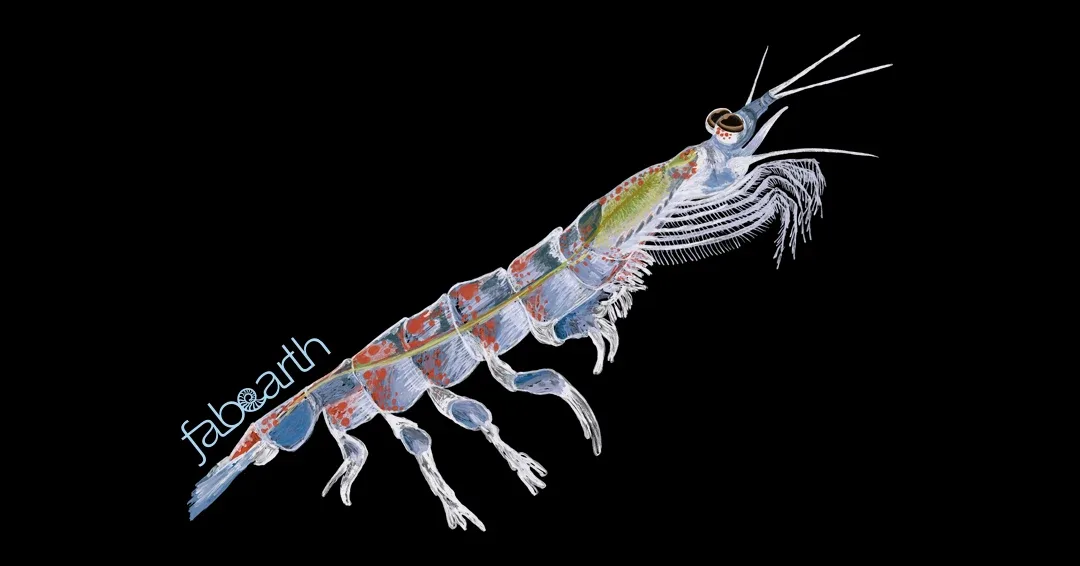
The krill feeds on phytoplankton in open water and on algae that grow under sea ice, using its front appendages like a fine basket. A single krill is easy to miss. A swarm becomes the way energy moves from microscopic plants into bodies big enough to surface, dive, hunt, and breed around Antarctica.
The eggs sink first
Antarctic krill reproduction begins near the surface. In summer, a female can release several broods, with up to ten thousand eggs in a brood.
The eggs do not stay where they are laid. They sink into deep water before hatching. The larvae then begin the return journey toward the surface, changing form as they grow.
That first journey makes sea ice part of the nursery. Young krill feed on algae under the ice, where food is available through a season when the open ocean can be dark and lean. Changes in sea ice, temperature, and ocean chemistry can therefore reach krill early, before the animal has joined the adult swarms.
Adults carry another winter trick. They keep moulting after maturity, and when food is scarce they can reduce body size rather than only wait out hunger. Laboratory studies have kept Antarctic krill alive for more than two hundred days without food.
Where the catch happens matters
Antarctic krill are commercially harvested, but the fishery sits inside a different kind of management problem from many single-species fisheries. The question is not only how much krill can be removed from a large biomass. It is also where and when catches happen, because predators need krill in particular feeding places during particular seasons.
CCAMLR, the Commission for the Conservation of Antarctic Marine Living Resources, manages the krill fishery with catch limits and monitoring built around that ecosystem question. Its precautionary approach exists because a catch that looks small at the scale of the whole Southern Ocean can still matter if it concentrates near breeding penguins, seals, or other predators.
Keeping abundance in the right places
Least Concern does not mean the Southern Ocean can lose krill without consequence. It means Antarctic krill, assessed as a species, is not currently classed as threatened with extinction.
The sharper conservation question is how much change the krill system can absorb. Warming water, shifting sea ice, ocean acidification, and concentrated fishing pressure do not act on krill in isolation. They press on the same cold-water chain: algae under the ice, krill in the water, predators arriving where the swarm should be.