Wallace's Flying Frog
Rhacophorus nigropalmatus
A canopy frog that steers its own fall — and drops its tadpoles into a puddle stamped out by a much larger animal.
Wear it on a T-shirt
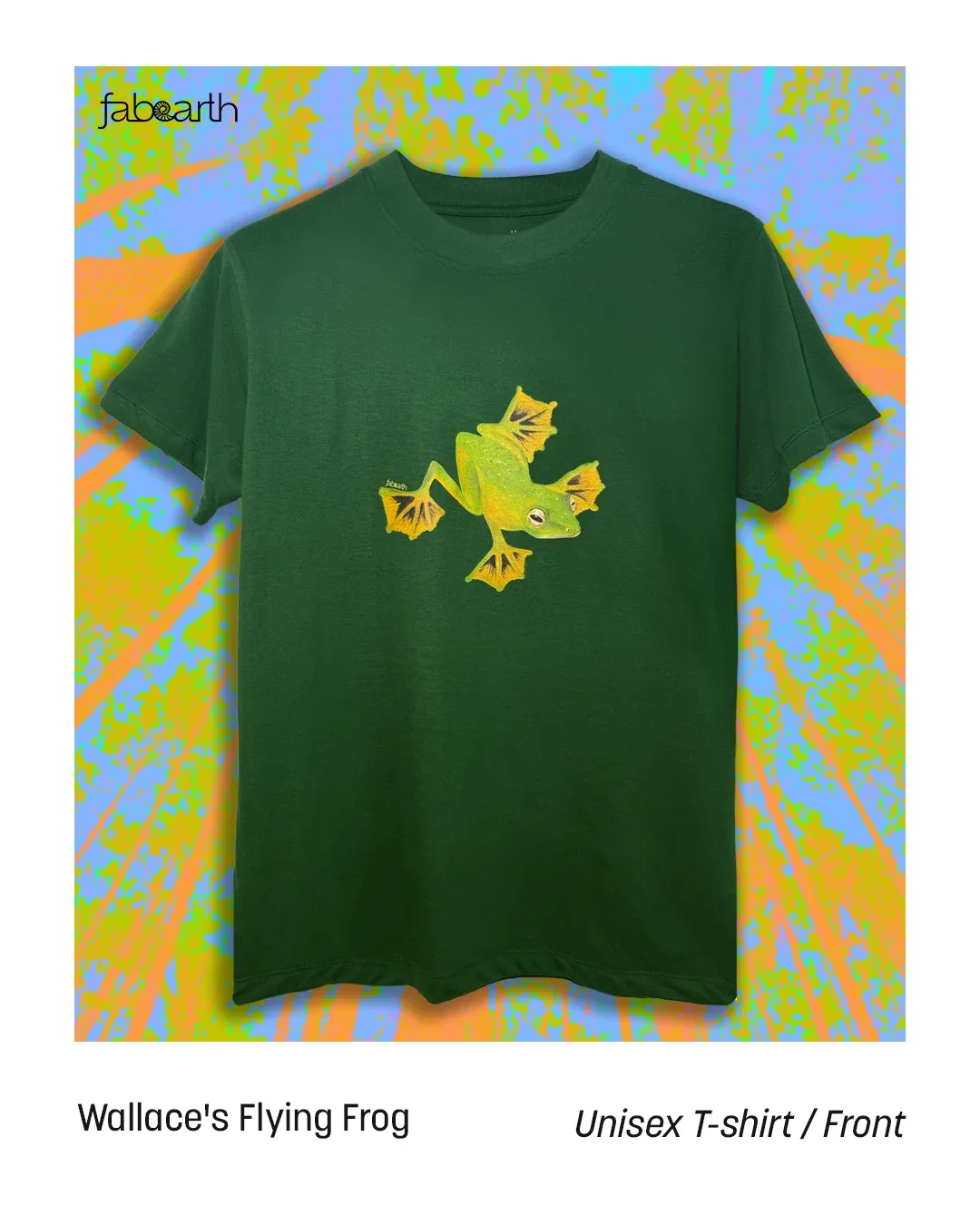

T-shirt Regular Unisex Bottle Green
₹899Ships todayThe frog a workman brought to Wallace
In Sarawak in the 1850s, a workman brought Alfred Russel Wallace a frog he had just watched come down from a high tree. It had not dropped, the man said. It had come down at an angle, far out from the trunk, as though it had flown. Wallace turned it over and found the account easy to believe:
"On examining it, I found the toes very long and fully webbed to their very extremity, so that when expanded they offered a surface much larger than the body."
Forty years later George Albert Boulenger described the species formally and named it for Wallace, whose years in this archipelago had by then helped shape the theory of evolution by natural selection. Wallace's Flying Frog (scientific name: Rhacophorus nigropalmatus) is a large tree frog of Sundaland — the Malay Peninsula, southern Thailand, Sumatra, and Borneo.
Its conservation status is Least Concern, which it owes to the size of its range.
How a frog steers a fall
It does not fly. It falls on purpose, and slowly.
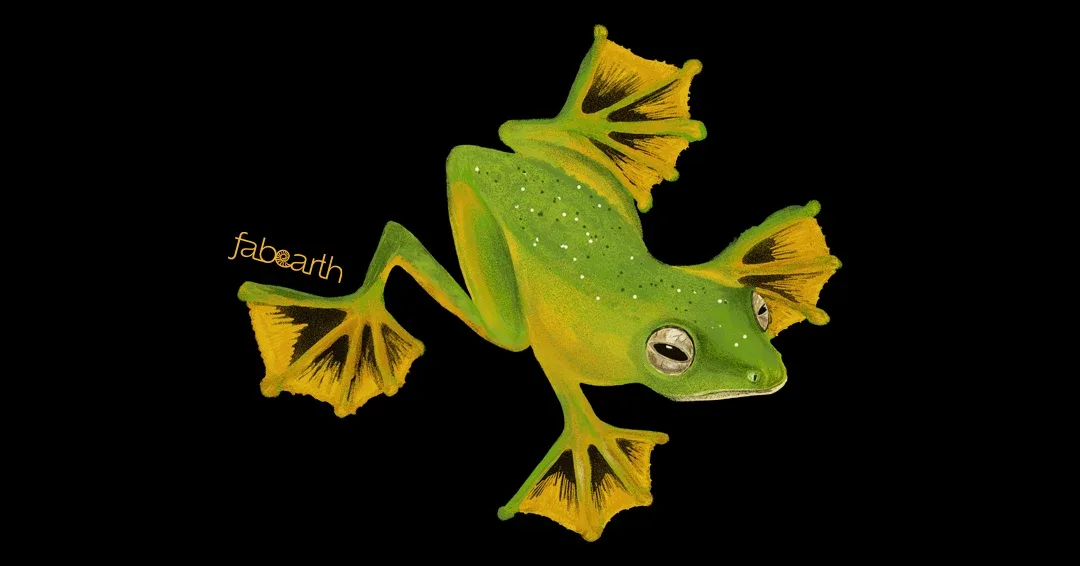
The frog is built for it. Its fingers and toes are webbed right to the tips, loose flaps of skin trail along its forearms and shins, and every digit ends in a broad pad. Spreading all four feet at once, it catches enough air to travel sideways as it drops — fifteen metres or more from one tree to the next, coming in at a shallow angle to land pads-first against the trunk.
And it is a big animal to be doing this. Females reach about a hundred millimetres from snout to vent and males about ninety, among the largest frogs in the genus — a bright green frog the size of your hand, gliding from tree to tree.
The rest of its colouring stays out of sight: a pale underside, brilliant yellow along the inner toes and the outer edge of the webbing, and jet black where the webs meet the body. Sitting on a leaf with its feet folded under it, the frog is just green. All of it appears when it spreads its feet.
The nursery is a puddle
Adults live in the treetops. They come down for one thing.
A breeding female beats her secretions into a foam nest and fixes it to a branch overhanging water, or to bare mud. When the tadpoles are ready they drop out of the bottom of it into whatever is below.
What is below is rarely a clean forest stream. More often it is a shallow, short-lived pool of the kind that collects in a hollow where a heavy animal has wallowed. Bearded pigs make those hollows. Rhinoceroses made them too.
Why this one is hard to count
A green frog at the top of a rainforest canopy is close to uncountable. Most of what is known about where this one still breeds comes from people standing beside forest pools at night in the wet season, listening for males calling.
It turns up across several large islands, in logged forest as well as untouched forest, sometimes in plantations, from the lowlands to around two thousand metres.
But it does best in lowland and hill forest, which is the easiest ground to clear and the first to go.
The animals it depends on
Its own conservation status is comfortable. The animals it breeds under are not: the bearded pig is listed as Vulnerable, and the Sumatran rhinoceros is down to a few dozen animals.